Visual Note · Harper Lee · American literature · literature study
To Kill a Mockingbird — The Courthouse and the Porch
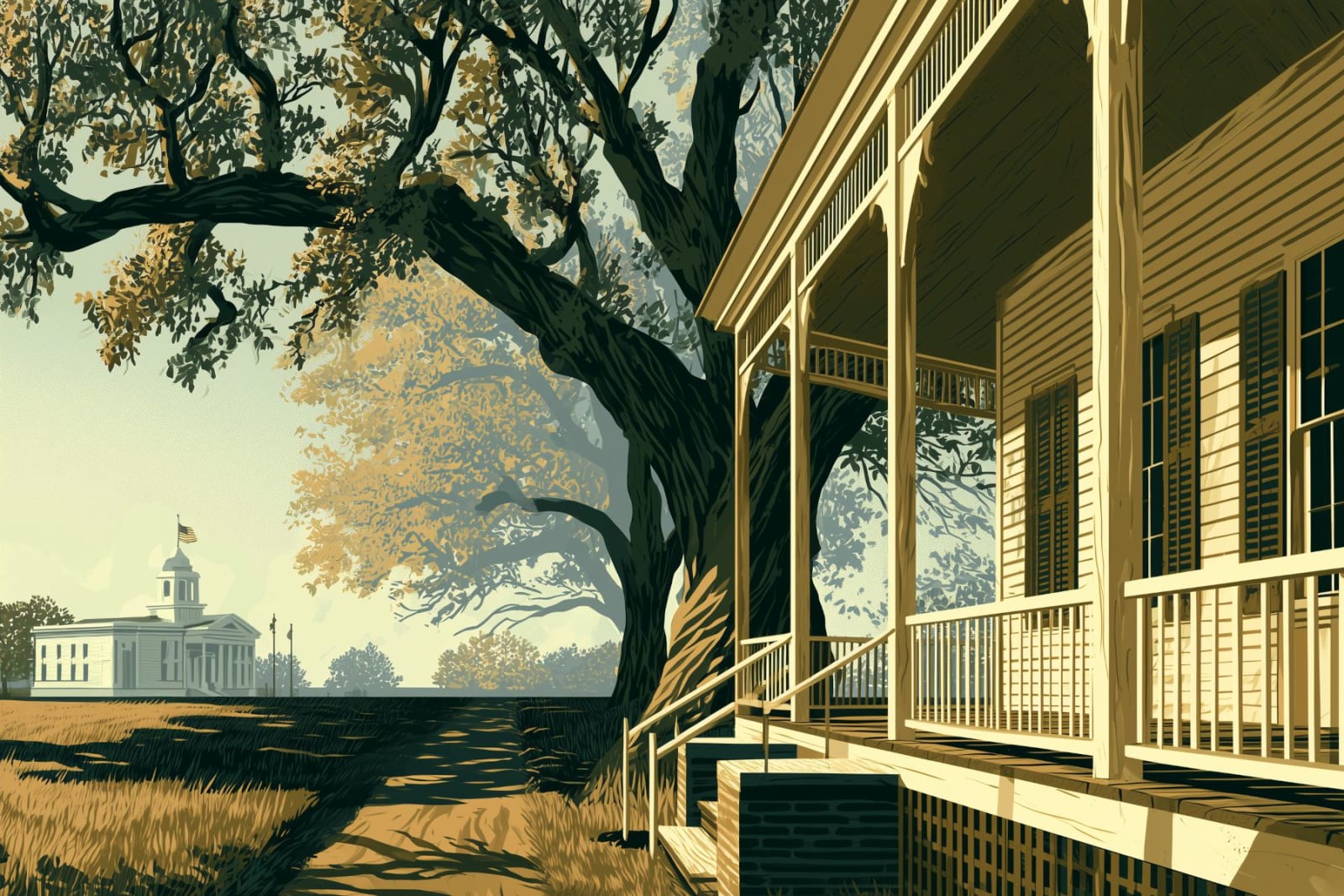
Scout’s education unfolds between the courthouse and the porch, where racial hierarchy, public judgement, and private recognition collide.
To Kill a Mockingbird is a novel about how a child learns to see the difference between moral language and moral reality. Scout Finch grows up in Maycomb, Alabama, surrounded by stories about courage, family, reputation, law, race, and belonging. The people who teach her do not all agree, and the institutions that claim to administer justice often protect the hierarchy they are supposed to correct.
The novel’s central movement is not simply from innocence to knowledge. It is from a child’s confidence in the stories adults tell toward a more difficult recognition of partial vision. Atticus gives Scout a vocabulary of conscience. Calpurnia gives her access to a community the Finch household does not control. Tom Robinson’s trial reveals the limits of evidence inside a racial hierarchy. Boo Radley’s story teaches her that recognition does not require possession.
At a glance
| Author | Harper Lee |
| Genre | Southern Gothic novel / coming-of-age fiction |
| Publication | 1960 |
| Commonly studied in | High school and introductory college literature |
| Central problem | Can moral understanding become justice inside an unequal social order? |
The novel’s pressure points
Moral education is larger than Atticus’s lessons. Scout learns from her father, but also from Calpurnia, Jem’s grief, Tom’s testimony, Mayella’s contradictions, Aunt Alexandra’s social expectations, and Boo’s refusal of public performance.
Justice and procedure are not the same thing. The courthouse follows rules and rituals, but the trial demonstrates that orderly procedure can preserve racial inequality rather than correct it.
Race and credibility shape who is believed before evidence is heard. Tom Robinson’s humanity is visible to some characters, but recognition does not become equal treatment.
Privacy and recognition move in opposite directions. Maycomb turns Boo’s absence into a public story; Scout’s final act is to see him without demanding that he surrender the privacy the town has denied him.
Innocence and humanity are not identical. The mockingbird metaphor identifies needless harm, but people should not have to prove themselves harmless before they receive equal protection.
Characters to track
- Scout Finch — a child narrator whose education involves learning what her community’s categories conceal.
- Jem Finch — Scout’s older brother, whose grief after the verdict marks the collapse of his faith in evidence and fairness.
- Atticus Finch — a principled lawyer and father whose moral example is important but insufficient to repair Maycomb’s institutions.
- Calpurnia — the Finch family’s Black caregiver, whose authority, language, and community exceed the role assigned to her.
- Tom Robinson — a Black man whose trial exposes the racial distribution of credibility and legal protection.
- Boo Radley — a private neighbour transformed into a public myth, who becomes the person Scout learns to recognize without possessing.
- Mayella Ewell — a poor and isolated white woman whose vulnerability coexists with racial power over Tom.
- Aunt Alexandra — the Finch family’s connection to Maycomb’s inherited rules about class, gender, family, and reputation.
Motifs and formal devices
The mockingbird gives the novel a language for needless harm, but it is an invitation to ethical thought rather than a complete system of justice.
The courthouse presents equality as an ideal while organizing inequality as a fact. Its physical arrangements and legal rituals make social hierarchy appear orderly.
The Radley house changes from a site of rumour into a place of privacy. The final porch scene reverses the direction of the children’s gaze without granting them total knowledge of Boo.
Language and naming determine who is treated as a person and who is reduced to a type. Calpurnia’s code-switching, Tom’s testimony, and the town’s descriptions of Boo all reveal language as social power.
Memory allows the adult Scout to revisit childhood without turning the past into a solved lesson. The story preserves both moral insight and the limits of the perspective that produces it.
Questions worth asking
- Is Atticus a complete moral guide, or only the beginning of Scout’s education?
- How does the courthouse make injustice appear orderly?
- What does Calpurnia’s authority reveal about labour, race, and belonging?
- Why does Tom Robinson’s humanity fail to produce equal treatment?
- What is the difference between seeing Boo and possessing his story?
- Can the mockingbird metaphor identify harm without reducing people to innocence?
The essays behind the note
The Visual Note is the orientation. The individual arguments develop these questions in the Reading To Kill a Mockingbird series:
- Atticus Finch Is Not the Whole Story — why Scout’s education exceeds her father’s lessons
- Maycomb Teaches Children What Justice Costs — how procedure can preserve inequality
- Calpurnia’s Authority Is Larger Than Her Role — language, labour, and belonging
- Boo Radley and the Ethics of Being Seen — privacy, projection, and recognition
- Tom Robinson Cannot Be Saved by Understanding Alone — the limits of empathy without institutional change
- The Mockingbird Is Not a Moral System — innocence, memory, and the need for political language
The courthouse and the porch name the movement of the novel: from a public institution that refuses equal justice to a private threshold where recognition finally requires restraint.