Visual Note · Shakespeare · tragedy · literature study
Romeo and Juliet — Love, Violence, and Social Pressure
Verona’s private hopes are shaped by family allegiance, public violence, and the absence of safe social space.
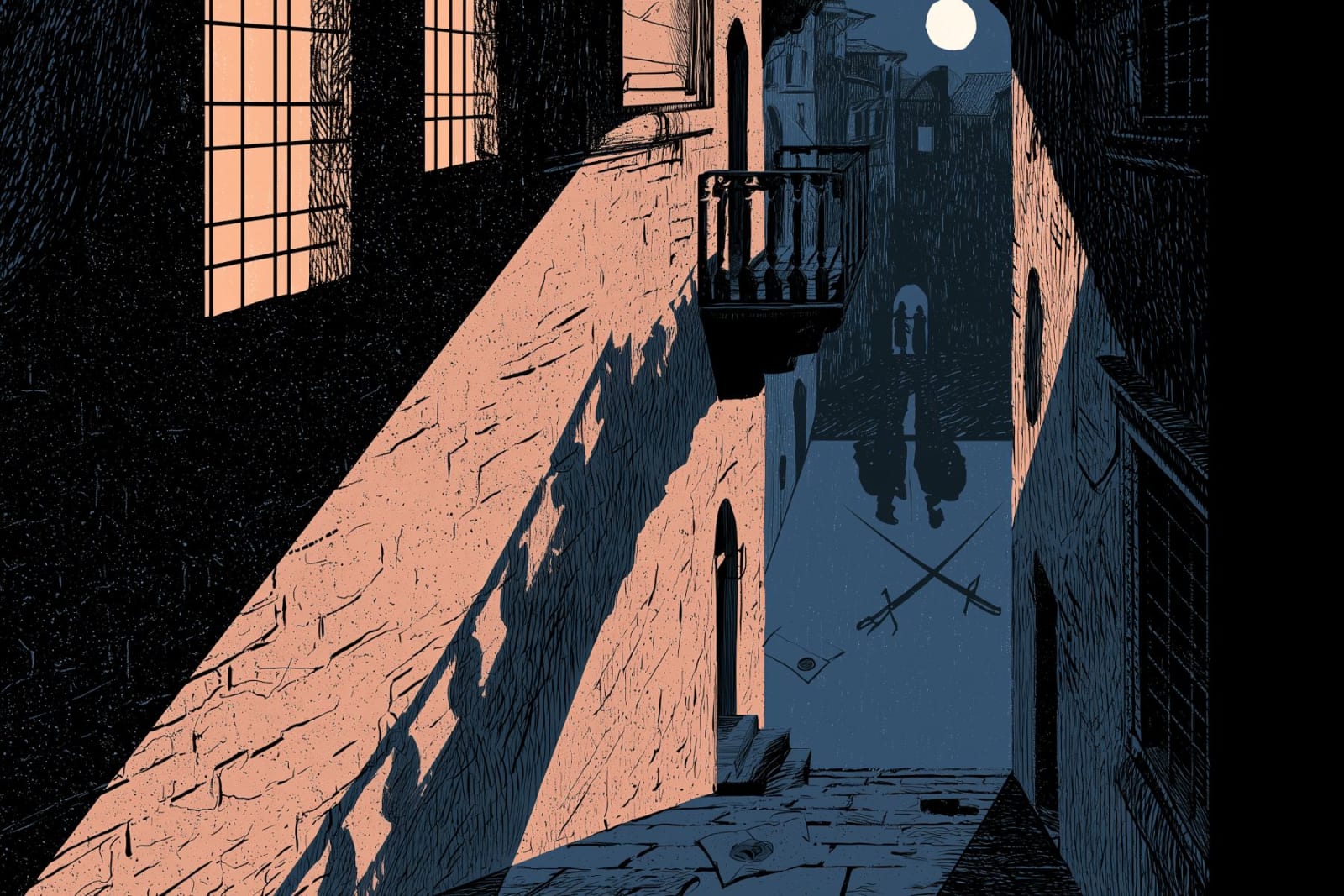
Romeo and Juliet is not only a tragedy about two young people who love too quickly. It is a tragedy about what happens when private feeling meets a social world that rewards haste, violence, obedience, and secrecy. The lovers make consequential choices, but they make them inside a city that offers no dependable space in which those choices can be spoken, tested, and protected.
At a glance
| Author | William Shakespeare |
| Genre | Tragedy |
| Date | c. 1595 |
| Commonly studied in | High school and introductory college literature |
| Central problem | What happens when private love has no safe public form? |
The play’s pressure points
Love and social structure are inseparable. Romeo and Juliet’s relationship is private, but their names, families, marriage, and public reputation make privacy unstable from the beginning.
Haste and hope are linked. Speed can look reckless from a distance, yet delay offers the lovers little protection. The play’s urgency comes from a closing set of options rather than from impatience alone.
Fate and choice remain deliberately entangled. Prophecy, dreams, stars, and fortune give the catastrophe a cosmic frame, but human decisions, violence, and failed communication create the route by which that frame becomes real.
Violence and performance turn masculinity into a public test. Mercutio, Tybalt, and Romeo each respond to an honour culture in which restraint can be read as weakness and escalation as necessity.
Juliet and authority reveal constrained agency. Her courage grows as Capulet authority, the Nurse’s intimacy, and the Friar’s institutional plan each fail to provide a safe form of protection.
Adult care and control are not the same thing. Capulet, Lady Capulet, the Nurse, Friar Laurence, and the Prince each try to manage danger, but their divided loyalties and reactive decisions leave the young to absorb the consequences.
Questions to carry into the essays
- Is the tragedy caused by the lovers’ choices, the social world around them, or the interaction between the two?
- Why does haste feel like protection when it also makes decisions irreversible?
- What does fate explain, and what does it leave human beings responsible for creating?
- How does public reputation turn violence into a performance?
- What kind of agency remains when family authority withdraws protection?
- When does care become another name for control?
The essays behind the Visual Note
The Visual Note is the orientation. The individual arguments develop its questions in the Reading Romeo and Juliet series:
- Romeo and Juliet Are Not Defeated by Love Alone
- Haste Is the Play’s Most Dangerous Form of Hope
- Fate Names a Tragedy That People Still Create
- Mercutio Shows How Violence Becomes a Social Performance
- Juliet’s Courage Begins Where Family Authority Ends
- The Adults of Verona Mistake Control for Care
The Visual Note gives the reader a way into the play. The six essays slow down over the interpretive problems that a classroom essay might ask the reader to solve.