Visual Note · John Steinbeck · American literature · literature study
Of Mice and Men — The Riverbank and the Dream
George and Lennie’s dream of a home exposes the novella’s economies of loneliness, care, exclusion, and precarious hope.
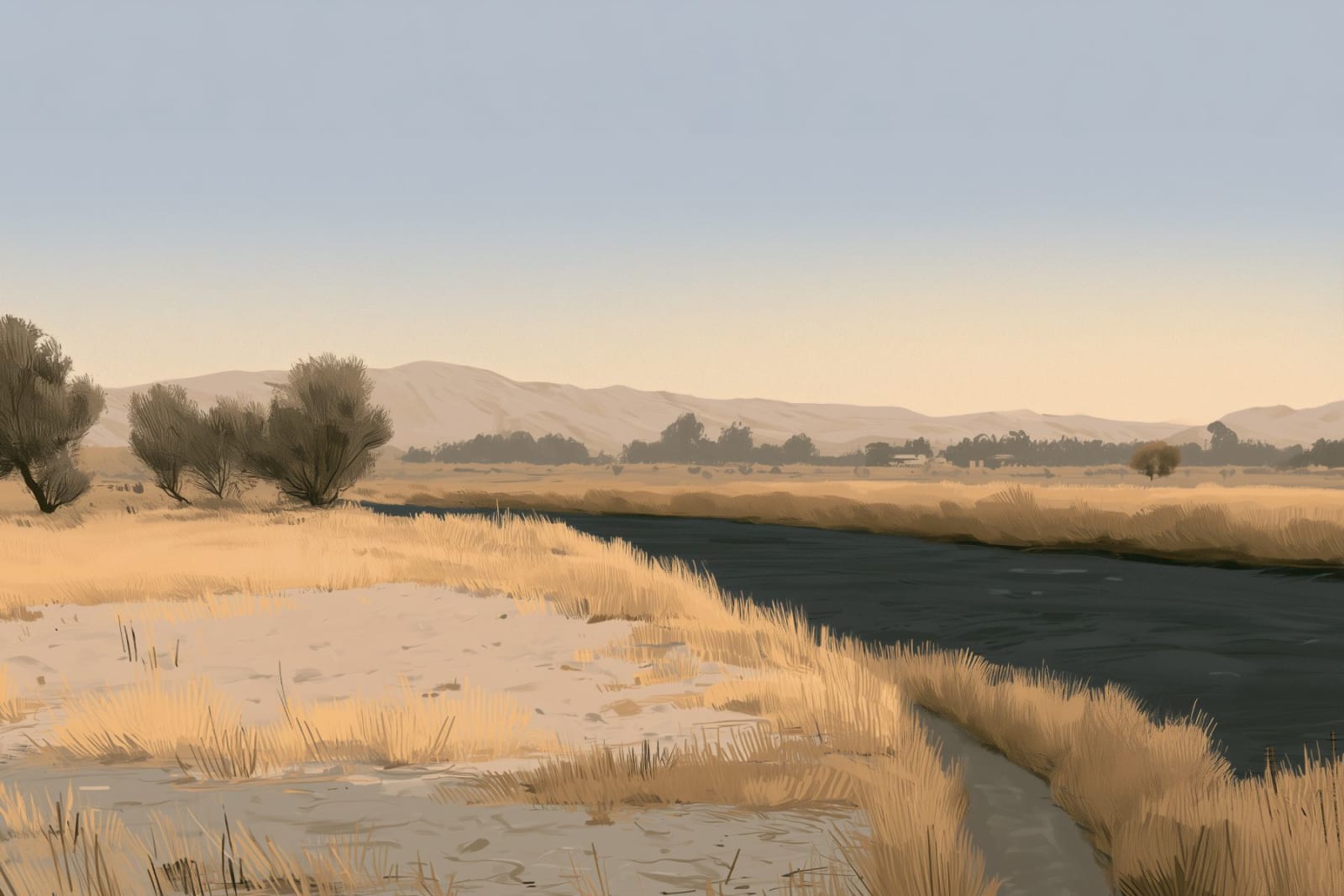
Of Mice and Men is a short novel about a large hope carried by two people who have almost nothing. George and Lennie move through a world of temporary work, unstable shelter, and unequal power while imagining a small farm of their own. The dream gives their friendship a future to speak toward, but the novel keeps asking what happens when care cannot protect someone from the conditions surrounding them.
At a glance
| Author | John Steinbeck |
| Genre | Novella |
| Date | 1937 |
| Commonly studied in | High school and introductory college literature |
| Central problem | Can friendship make a humane life possible inside an inhumane economy? |
The novella’s pressure points
The American Dream appears as a story George and Lennie repeat until it becomes almost a shared possession. The farm represents independence, safety, and belonging, but its emotional power also reveals how little security the ranch workers possess in the present.
Friendship and loneliness are not opposites in the novel. George and Lennie’s companionship makes their lives unusual, yet their dependence on one another also exposes how vulnerable friendship becomes when one person must act as another’s guardian.
Strength and vulnerability are distributed unevenly. Physical power, economic power, racial power, and social authority do not mean the same thing, and the novel repeatedly shows strong characters exercising power over those who cannot safely resist them.
Mercy and responsibility become inseparable near the end. Steinbeck does not make the final decision emotionally simple; he makes the reader weigh care, violence, protection, and the absence of humane alternatives.
Characters to track
- George Milton — Lennie’s companion and protector, whose responsibility is also a source of exhaustion, love, and moral conflict.
- Lennie Small — physically powerful and cognitively vulnerable, whose longing for soft things exists alongside consequences he cannot fully anticipate.
- Candy — an aging ranch hand who recognizes the farm dream as a possible escape from disposability.
- Crooks — a skilled worker isolated by racism, whose intelligence makes the ranch’s social order impossible to mistake for a natural one.
- Curley’s wife — unnamed by the narrative, she is both constrained by the ranch’s gender order and capable of using the limited power available to her.
- Curley — a figure of insecure authority whose violence is tied to status, possession, and fear of humiliation.
Motifs and formal devices
The farm story functions as a refrain. Each retelling changes slightly according to who is listening, which makes the dream both a plan and a form of emotional shelter.
Animals connect tenderness, labor, ownership, and vulnerability. The rabbits, the puppy, Candy’s dog, and the other animals make the novel’s treatment of care impossible to separate from the question of who is allowed to survive.
Places of refuge are never fully outside social power. The riverbank appears peaceful, but it is also where the novel begins and ends, enclosing the narrative in a pattern that George cannot finally escape.
Foreshadowing gives ordinary actions a second meaning. The reader is taught to notice hands, softness, dead animals, and repeated warnings before the final crisis makes those details unavoidable.
Recurring essay questions
- Is the American Dream genuinely available to George and Lennie?
- Is George a loyal friend, a reluctant caretaker, or both?
- How does Steinbeck portray loneliness as a social condition rather than a private feeling?
- What do Crooks, Candy, and Curley’s wife reveal about exclusion on the ranch?
- How does the treatment of animals shape the novella’s ideas about mercy and power?
- Is the ending an act of mercy, an act of violence, or an impossible mixture of both?
The essays behind the map
The Visual Note is the orientation. The individual arguments will live in the Reading Of Mice and Men series as they are developed and reviewed:
- The Farm Is a Promise, Not a Plan — the dream’s emotional force and material impossibility
- George Milton’s Burden of Care — friendship, guardianship, and responsibility
- The Loneliness Steinbeck Builds — isolation as an economic and social condition
- Crooks Knows the Dream Is Unequal — race, exclusion, and the limits of shared hope
- The Ranch Has More Than One Kind of Power — gender, status, strength, and vulnerability
- Mercy at the Riverbank — how the ending refuses an easy moral answer