Visual Note · Shakespeare · tragedy · literature study
Hamlet — Delay, Evidence, and Revenge
Hamlet turns watching, evidence, mortality, and political disease into a tragedy of action under uncertainty.
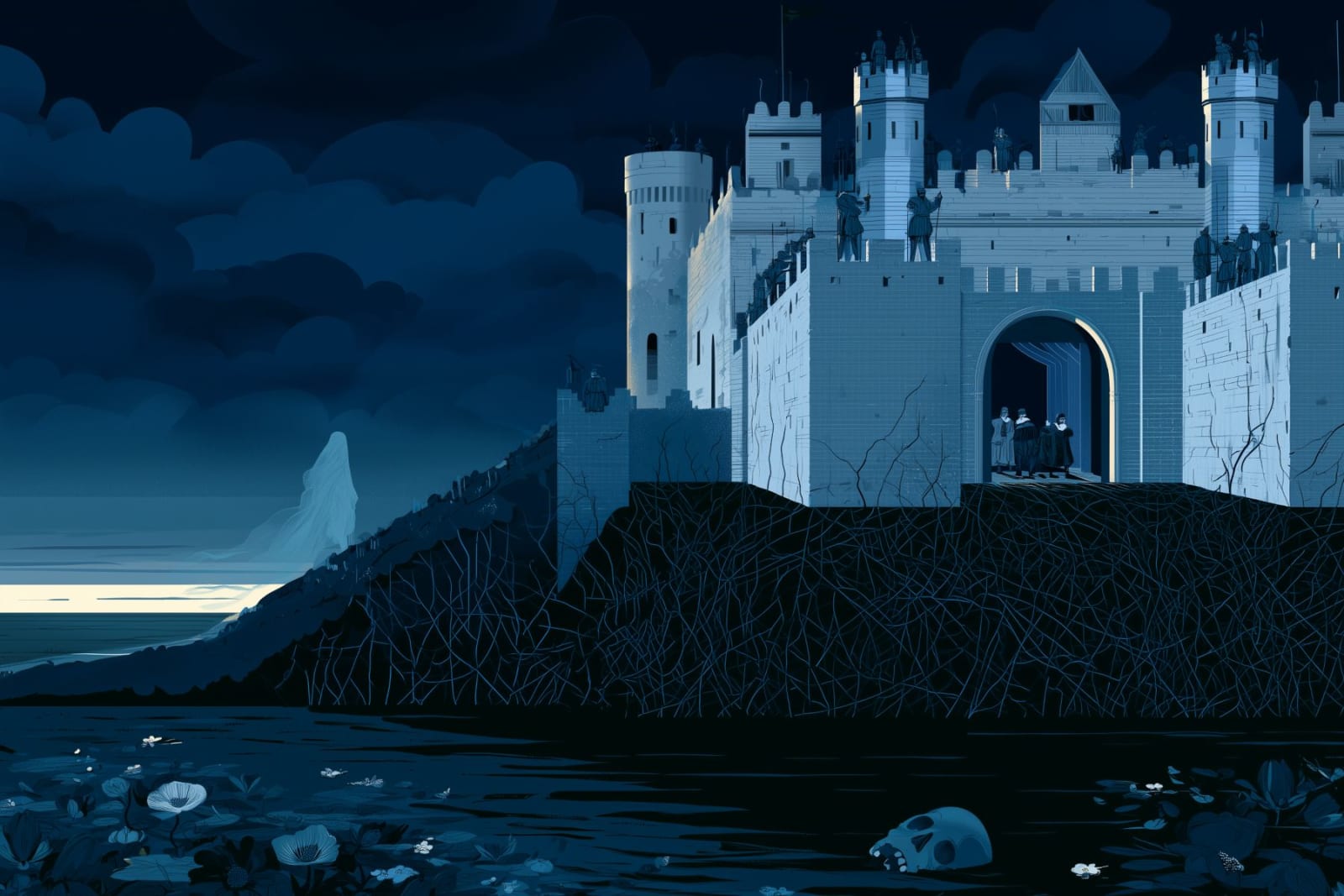
Hamlet is a tragedy about the cost of acting when evidence is compromised. A ghost gives Hamlet a command, a theatre performance tests the command, a court turns private life into surveillance, and a diseased political order makes every response more dangerous. The play does not ask only why Hamlet delays. It asks what anyone can responsibly do when truth must be interpreted before violence can be justified.
At a glance
| Author | William Shakespeare |
| Genre | Tragedy |
| Date | c. 1600–1601 |
| Commonly studied in | High school and introductory college literature |
| Central problem | How can a person act responsibly when every source of knowledge is partial, staged, or compromised? |
The play’s pressure points
Action and delay are not simple opposites. Hamlet acts repeatedly, but he wants an irreversible action to become morally certain before he accepts responsibility for it. The tragedy begins when certainty proves impossible.
The Ghost and authority turn private grief into a demand for public violence. The Ghost offers a coherent accusation, but its supernatural status, theological ambiguity, and personal grievance prevent it from becoming an unquestionable witness.
Theatre and proof make performance into an evidentiary experiment. The Mousetrap produces a reaction from Claudius, but a reaction still needs interpretation and does not by itself determine what justice requires.
Ophelia and collateral damage reveal who pays for the court’s systems of watching. Her words, body, sexuality, grief, and death are repeatedly used to explain other people while she is denied stable authority over her own story.
Mortality and uncertainty turn “to be or not to be” into more than a question about suicide. The soliloquy examines how the unknown consequences of action or death can weaken the will to choose.
Political disease precedes Hamlet’s revenge. Denmark is already militarized, secretive, and unstable; Hamlet enters a state that has learned to conceal its wounds and then becomes entangled in the violence he seeks to expose.
Characters to track
- Hamlet — an investigator who turns grief into experiments, performances, and finally action, while never escaping the moral cost of interpretation.
- Claudius — a successful ruler whose public fluency conceals the murder and political illegitimacy beneath his authority.
- The Ghost — a supernatural witness whose command is compelling but cannot be cross-examined or fully authenticated.
- Gertrude — a queen caught between private loyalty, public ceremony, and competing accounts of what she can see and know.
- Horatio — Hamlet’s cautious collaborator and the witness asked to preserve a story after the catastrophe.
- Ophelia — a person repeatedly converted into evidence by family, prince, and court, whose fragmented speech resists complete possession by their interpretations.
- Polonius — a practitioner of surveillance who treats indirection as a legitimate way to produce knowledge.
- Laertes and Fortinbras — alternative models of action whose speed and political usefulness complicate Hamlet’s reflective hesitation.
Motifs and formal devices
Watching is the court’s ordinary language. Ghosts, sentinels, spies, hidden listeners, theatre audiences, and witnesses all ask what seeing can prove.
Poison and the ear connect bodily vulnerability to political secrecy. The murder enters through a hidden channel, and the play repeatedly asks what happens when testimony reaches the mind through compromised senses.
Disease and infection make corruption physical. The play’s ulcers, rot, and “imposthume” suggest damage festering beneath ceremonial order rather than a crisis created by Hamlet alone.
Performance and disguise blur the difference between appearance and truth. Hamlet’s antic disposition, Claudius’s public rhetoric, Ophelia’s songs, and the players’ reenactment all show that performance can conceal, expose, or contaminate knowledge.
Prayer, graves, and water place moral decisions beside unknowable consequences. Claudius’s failed prayer, Yorick’s skull, Ophelia’s drowning, and the final funeral make death both an event and an interpretive problem.
Recurring essay questions
- Is Hamlet’s delay cowardice, ethical caution, self-protection, or a mixture of all three?
- What kind of authority does the Ghost possess, and what would count as evidence against it?
- Does The Mousetrap prove Claudius’s guilt, or does it only produce a persuasive reaction?
- How does the court’s surveillance shape Ophelia’s tragedy and Hamlet’s apparent madness?
- Why does the “undiscovered country” remain unknowable after Hamlet has encountered the Ghost?
- Is Denmark diseased because Hamlet acts, or does Hamlet become violent because Denmark is already diseased?
The essay series behind the Visual Note
The Visual Note is the orientation. The individual arguments develop its questions in the Reading Hamlet series:
- Hamlet Does Not Simply Fail to Act
- The Ghost Gives Hamlet a Command, Not Certainty
- The Mousetrap Tests Guilt, Not Truth
- Ophelia Is Trapped in Other People’s Interpretations
- To Be or Not to Be Is Not Only About Death
- Denmark Is Sick Before Hamlet Acts
The Visual Note gives the reader a way into the play. The six essays slow down over the interpretive problems that a classroom essay might ask the reader to solve.