Essay · Books & Literature
Before the First Page: What a Book Cover Asks Us to Believe
Reading the original Gatsby jacket as an invitation to interpretation
Testing a writing framework conceived around qualitative superintelligence through Gatsby’s jacket, with notes on decisions, missed evidence, and revision.
Testing Depth and Clarity
This essay tests a writing framework conceived around what we call qualitative superintelligence: a thought experiment about what a substantially more capable intelligence might notice, connect, or question that we overlook. Depth and Clarity translates that question into a writing process. Here, we apply it to the original jacket of The Great Gatsby. Can it prompt us to see beyond an obvious resemblance, examine a missed detail, or reconsider what our evidence actually supports?
The literary argument is our worked example. We examine how the framework guides an interpretation, where its application misses something, and how feedback changes both the essay and the framework. We are testing what this premise contributes to a writing process. We are not testing a superintelligent system or claiming that current AI has achieved superintelligence.
The framework notes mark decisions made during drafting and revision. The closing assessment reviews all seven stages and separates observed changes from questions this attempt cannot answer. AI performed the research and drafting; this test does not measure the human editor’s independent writing ability or establish that the framework produces better essays.
An Image Before an Argument
Two eyes float in blue darkness. A red mouth hangs beneath them; below, a concentration of yellow and orange lights suggests a place of spectacle. The face has no solid outline. It seems to belong to the night while remaining separate from the illuminated world below.
This is Francis Cugat’s jacket for the first edition of F. Scott Fitzgerald’s The Great Gatsby. The image below shows its front panel. Earlier designs and the published jacket can also be compared on page 41 of the Fitzgerald Society’s illustrated article; those earlier designs should not be mistaken for the finished jacket (Cugat).
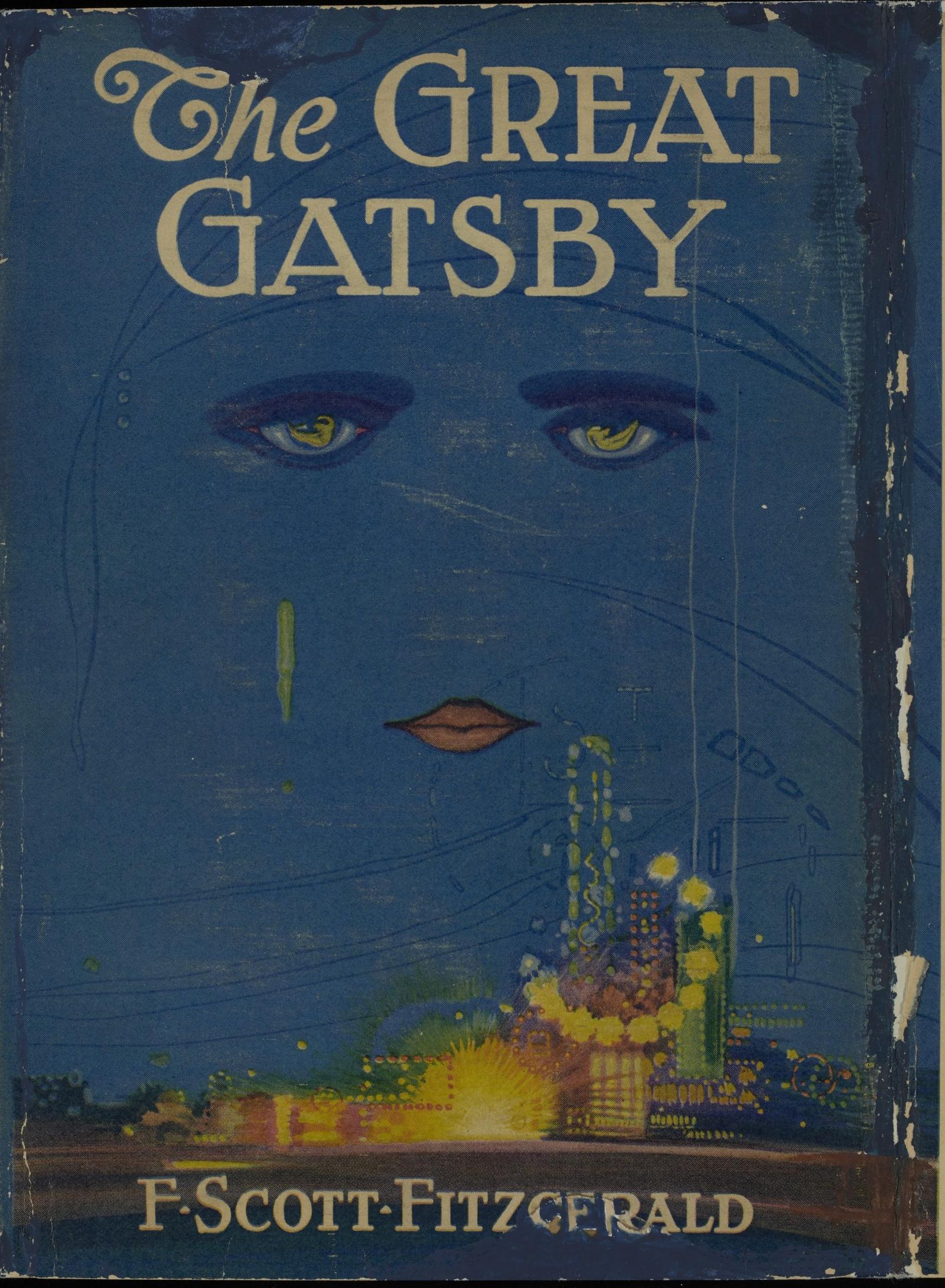
Before asking whose eyes these are, consider what the question assumes. It treats the cover as a puzzle whose solution must be a person or object inside the novel. Perhaps the image offers a different kind of relationship: a way of attending to desire, distance, and looking that several passages can develop.
Framework note — Stage 2: Examine the frame. The initial question encouraged us to identify an owner for the eyes. We changed the task to comparing defensible relationships between image and text. That allows an interpretation without claiming to know the designer’s intention or a reader’s actual response.
The distinction matters because a successful match can become a stopping point. Recognize a pair of eyes, name their supposed owner, and the cover appears explained. Yet an interpretation should account for what does not match as well as what does. The jacket becomes useful to this reading when it prompts questions that the novel can complicate.
This essay examines those possibilities. It does not establish how an actual audience responds to the cover. Its later discussion includes a passage from chapter VIII.
The Eyes That Almost Fit
The obvious candidate appears near the beginning of chapter II. Beside the road between West Egg and New York stands a billboard advertising Doctor T. J. Eckleburg. Fitzgerald gives its enormous eyes yellow spectacles and places them above a landscape of ash and dust. The commercial image remains after its maker has apparently ceased attending to it (Fitzgerald, ch. II).
Both images detach eyes from an ordinary human body and position them above a landscape. That resemblance makes the comparison worth pursuing. The differences make it worth pursuing carefully. The jacket has a mouth and no spectacles. Its bright lights differ from the billboard’s exhausted surroundings. Naming Eckleburg accounts for one visual relation while leaving much of the design unexplained.
We need not reject the connection because it is incomplete. A cover can transform an element rather than reproduce it literally. But that defence changes the claim: we are now arguing for a suggestive relationship, not identifying a straightforward illustration. The difference should remain visible in the essay’s language.
Framework note — Stage 3: Develop competing explanations. The mismatches prompted comparison with another passage. We kept the billboard reading in consideration: an alternative must account for relevant details, but it need not eliminate every other reading to be useful.
A Face Without a Fixed Owner
A second passage complicates the first. Near the end of chapter IV, Nick Carraway contrasts his immediate attraction to Jordan Baker with the absent women who occupy Gatsby’s and Tom Buchanan’s imaginations. He describes a woman’s face suspended among the city’s architecture and signs (Fitzgerald, ch. IV).
That image brings the jacket’s mouth, floating face, and night-time illumination into the comparison. It permits a reading concerned with desire: a person becomes an image large enough to occupy the surroundings. The cover’s distance between face and lights can then suggest the separation between an imagined figure and a world of material attractions.
A smaller detail gives this reading more specific support. Inside each eye is a tiny reclining figure, visible in both the printed jacket and the original painting below. The painting lets us examine the design without the printed title and author’s name. Princeton catalogues it as an original jacket design and gives its date as approximately 1925 (Cugat, Celestial Eyes).

Charles Scribner III identifies the figures as female nudes. His account also discusses both the billboard and chapter IV connections; those comparisons have a history in criticism (Scribner, opening discussion).
The figures bring bodies into the organs of sight. Reading the eyes as holding an image of desire now accounts for a particular feature that the first draft overlooked. This strengthens the thematic comparison with chapter IV, where an imagined woman occupies the cityscape. It does not establish that Cugat illustrated that passage: the figures could also belong to the jacket’s broader atmosphere of sensual spectacle. Nor do they rule out a transformed relationship with Eckleburg. The detail changes the weight of the argument towards desire without settling the image’s identity.
Framework note — Stages 4 and 5: Ground, challenge, and refine. Feedback flagged the figures that our first inspection missed. Larger reproductions and Scribner’s account supported a revision towards desire, followed by a check against the remaining alternatives. The omission also prompted a framework repair: check whether the source’s scale and quality permit the observation being made.
This is still an interpretation. It does not warrant labelling the jacket a portrait of Daisy, nor does it establish what Cugat intended. Replacing “Eckleburg” with “Daisy” would reproduce the original problem if the new name became another compulsory answer. The useful distinction is that the novel supplies more than one relevant visual relation.
The opening chapter offers a further check. Nick introduces himself through qualifications about judgement, privilege, and his own responses to other people (Fitzgerald, ch. I). The narrative does not simply confirm an atmosphere of glamour. It asks us to attend to the person describing that atmosphere and the distinctions he makes. A cover can suggest an emotional register while leaving the novel’s particular manner of thinking to unfold in prose.
What the History Can Establish
The publication history adds a connection but does not settle every identification. In his account of a surviving artist proof, Jim West quotes Fitzgerald’s request that Maxwell Perkins reserve the jacket, including the author’s statement that he had written it into the book. West describes the proposed connection with Eckleburg as critical speculation. His article also distinguishes the proof from the finished jacket (West 40–42).
The letter is encountered here through West’s account, not through inspection of the original correspondence. It supports a relationship between Fitzgerald’s writing and the developing jacket. By itself, it does not identify exactly which visual details became which passages. A statement of influence and a complete explanation of that influence are different kinds of claim.
This also changes the sequence implicit in the idea of a cover “interpreting” a finished book. In this case, the relation developed during production. The image need not be understood solely as a later summary laid over an already settled text. Establishing the precise direction and timing of particular influences would require further archival work.
The Risk of Turning an Image Into Authority
The novel supplies a particularly sharp warning about assigning meaning to a pair of eyes. In chapter VIII, George Wilson associates the billboard with God’s knowledge. Michaelis responds: “That’s an advertisement” (Fitzgerald, ch. VIII).
The exchange does not eliminate the image’s significance. It makes the act of giving it significance part of the scene. Wilson’s interpretation and Michaelis’s correction coexist in the text. An essay that simply declares the eyes to be divine judgement would conceal that friction.
Something comparable can happen in our reading of the jacket. Its position above the scene may suggest an overseeing presence. To convert that suggestion into the novel’s final moral authority would take another argumentative step—one that the text gives us reason to question.
There is an objection here: a cover must select. No small image could represent every qualification in a novel, and incompleteness alone is not a design failure. That objection should stand. The relevant question is whether our interpretation of the cover leaves room for what the book adds, resists, or changes. The responsibility belongs partly to the reader making the claim.
Framework note — Stage 5: Challenge and refine. Accepting this objection changed our criterion. The problem became an interpretation that refuses correction, rather than a cover that leaves things out. The conclusion below carries that change into the argument.
The most defensible conclusion is therefore modest. Cugat’s jacket offers several points of entry into Gatsby, but no single identification accounts for them all. We can read it as a proposal about the book, then allow the book to revise that proposal. The image before the first page remains available after the last one, with different questions attached to it.
What the Framework Test Showed
This essay applies Depth and Clarity, our working framework for examining an argument. The stages below record the actual direction of this AI-assisted draft; they are not results from a reader study.
- Establish the purpose. The starting question concerned when covers help or narrow interpretation. The scope became one jacket and selected passages, rather than a general account of cover design.
- Examine the frame. “What a cover asks us to believe” risks implying either designer intent or a measured reader response. The essay instead investigates what this image permits us to argue. Neither intention nor audience effect is inferred from visual resemblance alone.
- Develop competing explanations. The billboard connection was tested against the chapter IV face and a broader reading of desire and spectacle. The alternatives proved partly compatible; the draft therefore avoids manufacturing a winner.
- Ground the argument. Comparing the finished jacket with the text exposed the missing spectacles and the presence of a mouth. West’s article required a further distinction between a historical document reported by a scholar and an interpretation of its significance.
- Challenge and refine. The objection that every cover must simplify changed the conclusion. Selection alone does not make a cover misleading; our reading becomes restrictive when it refuses contrary details.
- Build the explanation. The argument follows the apparent match, the resistant details, the alternative passage, and the limits of the historical evidence. This gives the reader reasons to revise the first answer.
- Evaluate and learn. The exercise exposed a missing instruction in the framework: identify what kind of claim the evidence can answer. Visual analysis, production history, and audience research do different work. It also exposed a limit of this demonstration: an AI-written essay cannot establish that the human editor has gained independent writing ability.
Observed changes. Applying the questions produced a narrower scope, a qualified interpretation, and an explicit response to the objection about selection. Subsequent feedback led us back to the images and to further criticism. The revised essay gives desire more weight and credits earlier comparisons. These are traceable changes within this attempt; they do not tell us what an equally careful writer would have produced without the framework.
Repairs to the framework. The exercise prompted three additions: stage 2 distinguishes the object, its maker’s intention, and its audience’s response; stage 4 checks whether source scale, completeness, or quality permits the claimed observation; stage 7 records who performed the reasoning before assessing learning. Missing the figures despite an initial source check exposed a weakness in our application. The feedback loop made that omission actionable, but neither the loop nor the revised instructions guarantee that all consequential details have been found.
Still untested. We have not measured reader comprehension, independent human learning, or results across different essay questions. Repeated AI critique does not provide independent verification, and revising the essay does not improve the underlying AI’s intelligence. A useful next test would ask a human writer to apply the revised instructions to another question, explain a consequential revision in their own words, and record where the process still fails. The framework remains a concept under examination.
Source and Process Note
The novel was consulted in the Project Gutenberg transcription, using chapter locators. Jacket details were checked against the reproduction on page 41 of West’s article, then against Princeton’s larger images during revision. Scribner’s essay was read in an online transcription; the citation uses a textual locator because the transcription lacks print page breaks. The original painting, jacket, proof, and correspondence were not physically inspected. West remains the source for the reported correspondence and production history.
AI conducted the research, comparison, drafting, and initial critique recorded here. In this attempt, the framework provided a structure for comparing interpretations, checking support, and explaining revisions. Its practical contribution was to make decisions and unresolved questions visible, so they could be challenged and revisited. Feedback exposed an overlooked visual detail and prompted changes to both the essay and the framework. These results demonstrate its application; whether it consistently improves essay quality or independent writing ability remains to be tested.
Works Cited
- Cugat, Francis. Dust jacket for F. Scott Fitzgerald’s The Great Gatsby. Charles Scribner’s Sons, 1925. Special Collections, Princeton University Library. Digital PUL item ark:/88435/wm117t33s; catalogue record 993043553506421. Front-panel crop. Also consulted: jacket reproduction in Jim West’s “Jacket Required,” p. 41. ↩
- Cugat, Francis. The Great Gatsby [Book Jacket Design: Celestial Eyes]. ca. 1925. Gouache on board. Princeton University Library, Special Collections, Graphic Arts, GA 2006.02659. Digital reproduction; catalogue record 99106620773506421. ↩
- Fitzgerald, F. Scott. The Great Gatsby. 1925. Project Gutenberg, eBook no. 64317, updated 26 Jan. 2025. Chapters I, II, IV, and VIII. Electronic transcription; citations use chapters rather than print pagination. Accessed 9 Sept. 2026. ↩↩↩↩
- West, Jim. “Jacket Required: An Artist Proof of Francis Cugat’s Cover Illustration for The Great Gatsby Has Surfaced, Giving Insight into the Novel’s Production Process.” The F. Scott Fitzgerald Society Newsletter, vol. 30, Sept. 2022, pp. 40–42. Accessed 9 Sept. 2026. ↩
- Scribner, Charles, III. “Celestial Eyes: From Metamorphosis to Masterpiece.” Princeton University Library Chronicle, vol. 53, no. 2, winter 1992, pp. 141–55. doi:10.2307/26410056. Online transcription consulted at the F. Scott Fitzgerald resource site, fitzgerald.narod.ru; opening discussion of the irises and the chapter IV comparison. Accessed 9 Sept. 2026. ↩